
What the JCR Impact Factor List 2025 tells us about India’s place in global scholarly publishing
I did not plan to spend an evening doing this. A 1,218-page PDF arrived on my screen, titled the JCR Impact Factor List 2025, and what started as idle curiosity turned into a few hours of data work, a few cups of tea, and a finding that I could not quite shake off even after I closed the laptop.
The Journal Citation Reports Impact Factor is not everything in scholarly publishing. I know that. You know that. Anyone who has spent time inside the library and information science community of India knows that we have been saying it for years. And yet, the JIF remains the currency that global funders, tenure committees, university rankings, and research assessment exercises reach for first. It is the number that follows a journal around like a shadow. So when a list of over twenty thousand journals ranked by this number lands in front of you, you look.
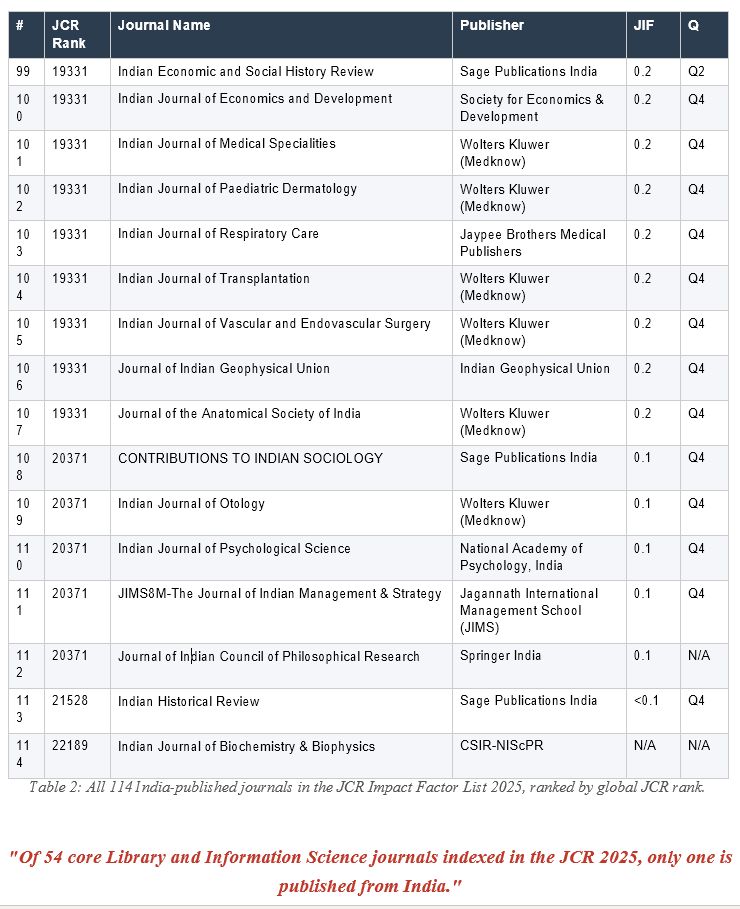
I extracted the data, cleaned it, deduplicated it, and then started asking it questions. The first question was simple: how many of these journals are published from India? The answer, after a careful two-pass classification, was 114 out of 20,449 indexed journals. That is 0.56 percent. A country that produces roughly nine percent of the world’s research output, with one of the largest populations of PhD holders on the planet, holds a little over half a percent of the world’s JCR-indexed journals.
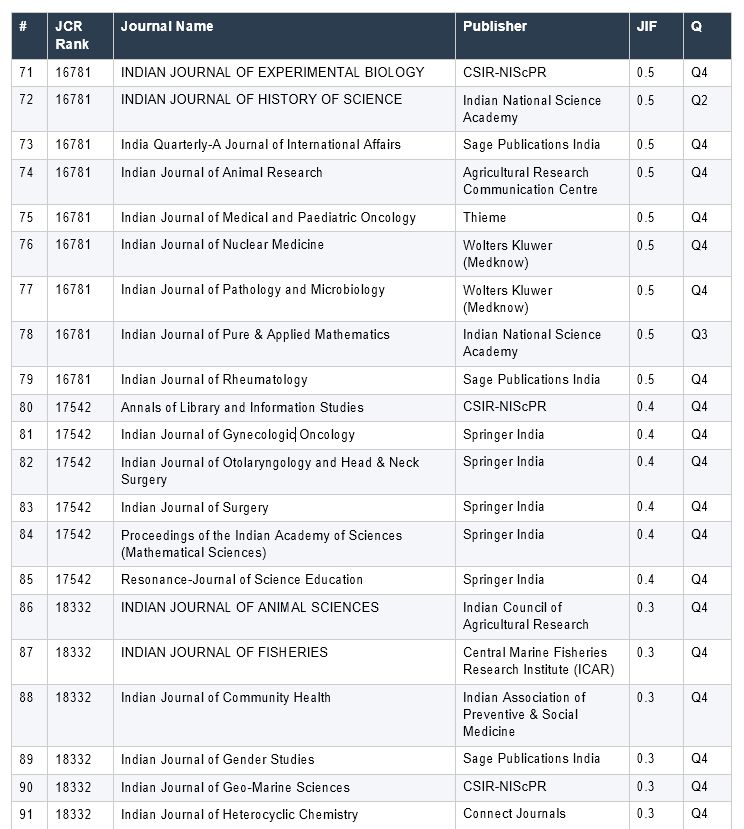
Then I narrowed the question further. Of the 54 core Library and Information Science journals indexed in the JCR, how many are published from India? Here the number does not even reach single digits. It is one. Just one. Annals of Library and Information Studies, published by CSIR-NIScPR in New Delhi, sitting at an impact factor of 0.4 in the fourth quartile. That is the entirety of India’s LIS contribution to the JCR universe.
I want to be clear about what this is and is not. It is not a condemnation of Indian LIS scholarship, which is substantial and growing. It is not a claim that JIF is the only measure that matters. What it is, I think, is an honest mirror. One that is worth looking into together.
Methodology
The source dataset was the JCR Impact Factor List 2025, edited by Dr. Niaz Ali and distributed as a PDF of 1,218 pages. The document recorded six fields per journal entry: global rank, journal title, publisher name, ISSN, Journal Impact Factor (JIF), and JCR quartile. Inspection of the file established that actual data was confined to pages 1 through 608, with the remaining 610 pages being blank, an artefact of the original Excel-to-PDF export.
Data were extracted using the pdfplumber Python library, processing each page sequentially in batches of 200 pages to avoid memory saturation. The raw extraction yielded 29,223 records. Exact-match deduplication across all six fields removed 8,774 duplicate rows (30 percent of the raw total) that arose from pdfplumber’s table reconstruction behaviour on multi-line cells, leaving a working dataset of 20,449 unique journal records.
A recurring extraction artefact required remediation. Where a journal title was long enough to wrap across two lines within its source cell, pdfplumber’s column-boundary algorithm occasionally interleaved characters from the adjacent Publisher, ISSN, JIF, and Quartile columns with the continuation of the title. This produced two classes of error: truncation of journal titles, and character-level corruption of numeric fields. Numeric JIF values were recovered by regular-expression search for a contiguous digit-decimal-digit pattern; where none existed, constituent digits were extracted in document order and reassembled, a heuristic validated against the monotonic ordering of JIF values within tied-rank groups. Garbled publisher strings were resolved using a letter-multiset containment test, treating each string as an unordered character bag and checking whether it contained the complete character set of a candidate publisher name. Truncated titles were corrected manually by cross-reference with the leaked characters visible in the adjacent corrupted Publisher field.
Identification of India-published journals proceeded in two passes. An initial pass flagged records whose Publisher field contained the strings INDIA, INDIAN, or MEDKNOW, excluding false positives such as Indiana University and Euskaltzaindia. This returned 44 records. A subsequent review, prompted by the absence of Annals of Library and Information Studies from this list (its publisher, CSIR-NIScPR, contains neither string), extended the classification to a three-criterion model: publisher string matching as before; publisher field matching a manually curated allowlist of known Indian institutional publishers; and journal title containing the word INDIAN or terminating in -INDIA on a word boundary. A total of 134 candidate records were individually reviewed; 20 were excluded as false positives (CSIRO via CSIR, University of Barcelona via BARC, and titles referencing Indigenous North American or West Indian contexts). The final list comprised 114 journals.
Limitations
This analysis operates entirely on publisher and title string inference because the JCR dataset carries no explicit country-of-origin field. Classification should therefore be treated as a best-effort approximation rather than authoritative country attribution. Journals are classified by the apparent national origin of the responsible academic society, not the registered domicile of the multinational publisher that may distribute them. A journal published by an Indian society but distributed by Elsevier or Springer under a generic imprint name, without India visible anywhere in the publisher string, would be missed by this methodology.
More fundamentally, the JCR list indexes only journals that receive a Journal Impact Factor through the Web of Science Core Collection. A significant body of Indian scholarly periodicals is indexed instead through Scopus, UGC-CARE, or DOAJ, and these do not appear in this dataset at all. The count of 114 should therefore be read as a floor, not a ceiling, and the analysis that follows as a measure of India’s presence in one specific tier of global scholarly publishing infrastructure, not a comprehensive census of Indian academic journals.
The World’s Top 20 Journals by JCR Rank (2025)
Before we arrive at India, it is worth stepping back and seeing what the top of this list looks like. The range of impact factors is staggering. The journal at rank one, CA-A Cancer Journal for Clinicians, carries an impact factor of 232.4, meaning that on average each of its articles is cited over two hundred times in a year. The twentieth journal on the list, Chemical Reviews, stands at 55.8. Every single entry in the top twenty is Q1, every single one is published from the United States or Western Europe, and Nature Portfolio alone accounts for eleven of the twenty slots.
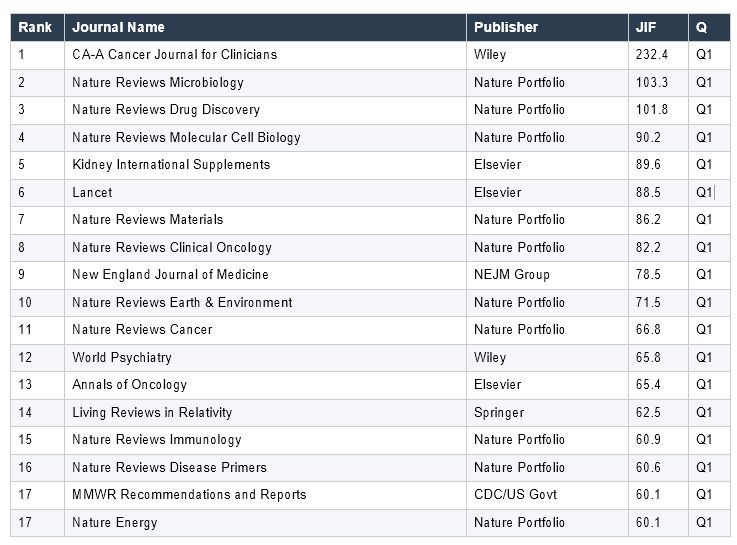

What you are looking at is a concentration of publishing power that has been building for decades. Nature Portfolio, Elsevier, Wiley, and the American Chemical Society between them account for the overwhelming majority of the highest-ranked journals in the world. These are not just publishers. They are infrastructure. And access to that infrastructure, for journals from the Global South, remains uneven.
India’s 114 JCR-Indexed Journals (2025)
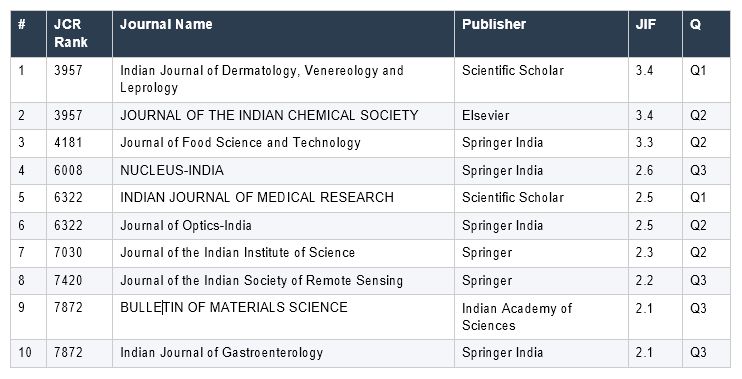
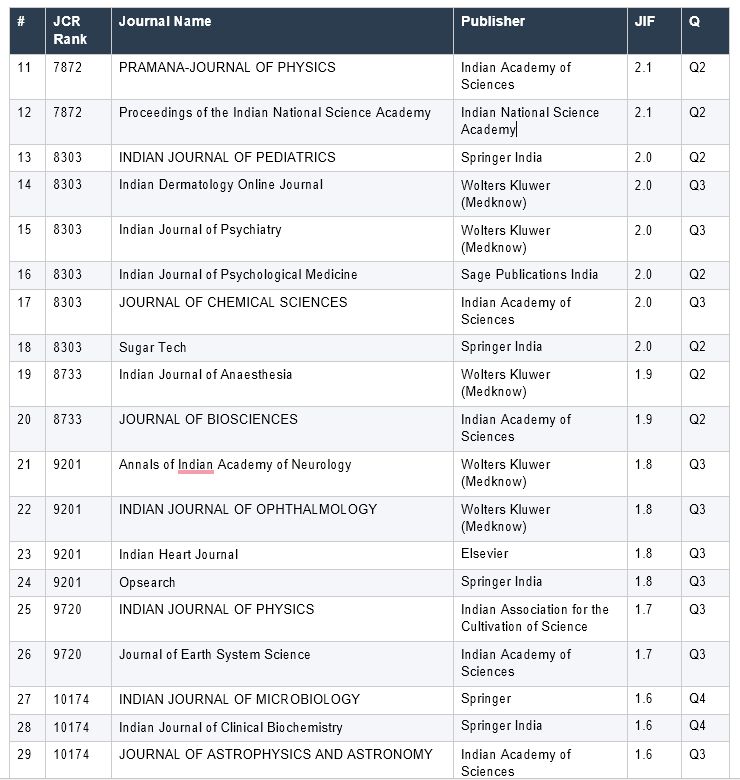
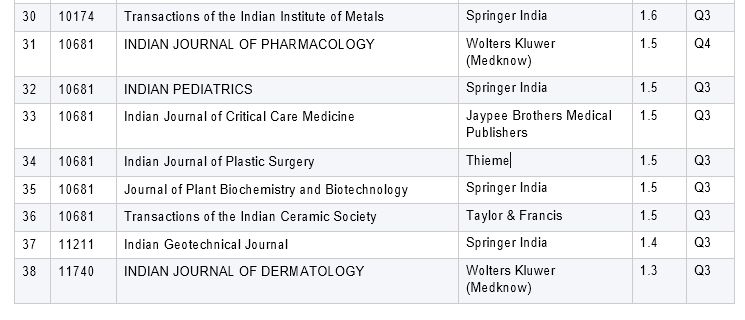
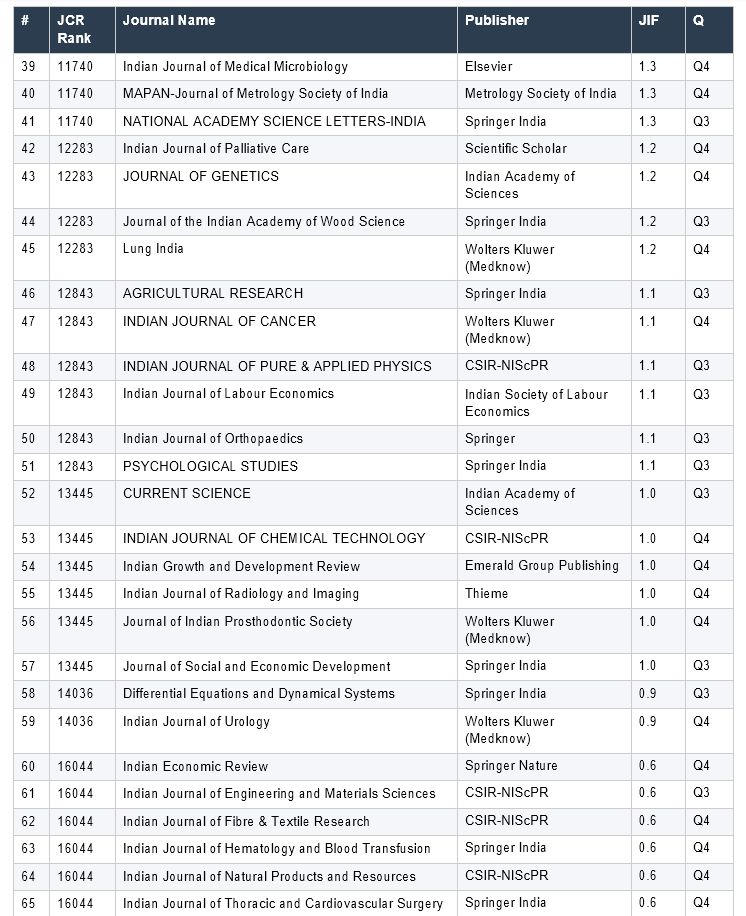
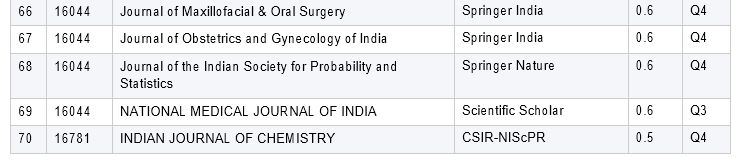
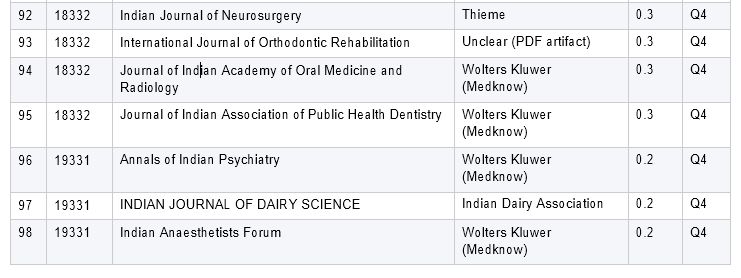
Of the 114 journals India contributes to the JCR list, the majority are distributed through Springer India, Wolters Kluwer’s Medknow imprint, or the Indian Academy of Sciences. The highest-ranked Indian journal is the Indian Journal of Dermatology, Venereology and Leprology, which sits at global rank 3,957 with an impact factor of 3.4, comfortably in Q1. The Journal of the Indian Chemical Society, also at rank 3,957 with a JIF of 3.4, shares that top position. Below them, the list thins rapidly into Q3 and Q4 territory.
Twelve of India’s 114 journals sit in Q1 or Q2. The remaining 102 are spread across Q3, Q4, and journals with no quartile assigned because their impact factor was either below the reportable threshold or not yet established. It is a picture of a publishing ecosystem that has genuine strengths in medicine, basic sciences, and a few applied disciplines, but has not yet built the breadth or depth that would make it a significant force in global citation metrics.
What Needs to Change: A Case for Strategic Government Intervention
The 114-journal count is not destiny. Other countries have moved this needle deliberately, through policy, funding, and institutional design. South Korea’s journal ecosystem grew substantially after the government introduced mandatory open-access infrastructure and tied research assessment to journal quality development, not just publication volume. Brazil built SciELO, a continental scientific publishing platform, in partnership with FAPESP and the Pan American Health Organisation, and today operates one of the largest open-access journal networks in the world. China’s investment in its national journal infrastructure over two decades is visible in the JCR list in ways that would have seemed implausible in 2000. India can do this. The question is whether we are ready to treat journal publishing as research infrastructure rather than an afterthought.
The following interventions, if implemented with seriousness and sustained funding, could shift India’s position in global scholarly publishing meaningfully within a decade.
1. A National Journal Quality Development Mission.
DST, UGC, and the Ministry of Education should jointly establish a Mission for Academic Journal Excellence, modelled loosely on the UK’s Research Excellence Framework but oriented toward journal development rather than research assessment. The mission would identify 50 to 100 high-potential Indian journals currently indexed in Scopus or UGC-CARE and provide them with five-year competitive grants covering editorial infrastructure, production quality improvement, international peer-review expansion, and indexing application support. The target would be JCR indexing for all mission journals within the grant period.
2. A National Open-Access Publishing Platform.
India needs its own SciELO. A government-funded, nationally administered open-access platform, hosted and maintained by an institution such as CSIR-NIScPR or IISc, would allow Indian learned societies and universities to publish their journals without dependence on expensive multinational distributor contracts. INFLIBNET has the technical capacity; what is needed is the political will to fund it at the scale required. Such a platform would also resolve the discoverability problem: Indian journals currently scatter across dozens of institutional websites with inconsistent metadata, broken DOIs, and irregular publication schedules. Centralisation would fix this.
3. Mandatory DOI Registration and Metadata Standards.
A journal without a DOI is essentially invisible to citation-tracking infrastructure. The UGC should make DOI registration mandatory for all journals seeking UGC-CARE listing, and should negotiate a bulk membership arrangement with CrossRef to subsidise registration costs for smaller Indian learned societies that currently cannot afford them. Simultaneously, a national metadata standard for Indian journals, aligned with Dublin Core and the JATS XML standard used by PubMed Central, should be mandated. Poorly structured metadata is one of the most common reasons Indian journals fail at the indexing application stage.
4. Editorial Capacity Building Programmes.
Many Indian journals have excellent content and committed editors who are simply not trained in the operational realities of international journal management: structured peer review workflows, COPE (Committee on Publication Ethics) compliance, conflict-of-interest management, retraction handling, and the technical requirements of indexing bodies. ICAR, CSIR, and the Indian National Science Academy should jointly sponsor annual editorial training programmes, and professional societies like ILA and IAMI should bring equivalent capacity-building into the LIS domain. A journal’s impact factor begins with the integrity of its editorial process.
5. Reform of Academic Promotion Criteria.
We cannot separate the journal ecosystem from the incentive structure that feeds it. As long as faculty promotion in Indian universities rewards the number of publications above the quality of the journals in which they appear, and as long as editing a national journal carries no credit in promotion committees, the pipeline of experienced editors and rigorous peer reviewers will remain thin. The UGC’s Academic Performance Indicators need a revision that explicitly values editorial contribution, peer review service, and journal development work as measurable academic outputs.
6. A Special Focus on LIS and Humanities Journals.
Science and medicine dominate India’s current JCR presence. The social sciences, humanities, and library science are almost entirely absent. ICSSR should establish a dedicated journal development fund for social science and humanities journals, with explicit performance milestones tied to Scopus and eventually JCR indexing. The LIS community in particular, with its expertise in metadata, indexing, and information architecture, is paradoxically well-placed to understand what makes a journal discoverable and citable. We should be leading this conversation, not observing it from the margins.
A Closing Thought
I started this piece with a 1,218-page PDF and ended up somewhere I did not entirely expect: thinking about what it means to build a knowledge infrastructure for a country of 1.4 billion people. Impact factors are an imperfect tool, and everyone in this room knows their limitations. But they are also a signal. And the signal from the JCR Impact Factor List 2025 is that India’s scholarly journals, for all the genuine research they carry, are not yet visible in the places where global scholarly conversations are being measured.
114 journals out of 20,449 is not failure. It is a starting point. What we do with that starting point is a policy choice, not a destiny. The researchers are here. The societies are here. The institutional memory, the networks, the LIS professionals who have spent careers building access to knowledge, all of it is here.
What we need now is for the people who control the budgets and the policy levers to look at the same number I looked at that evening, 114 out of 20,449, and decide that it is time to change it.